By Dr. Blayne Mozisek, MS, DVM, MAM, DACPV
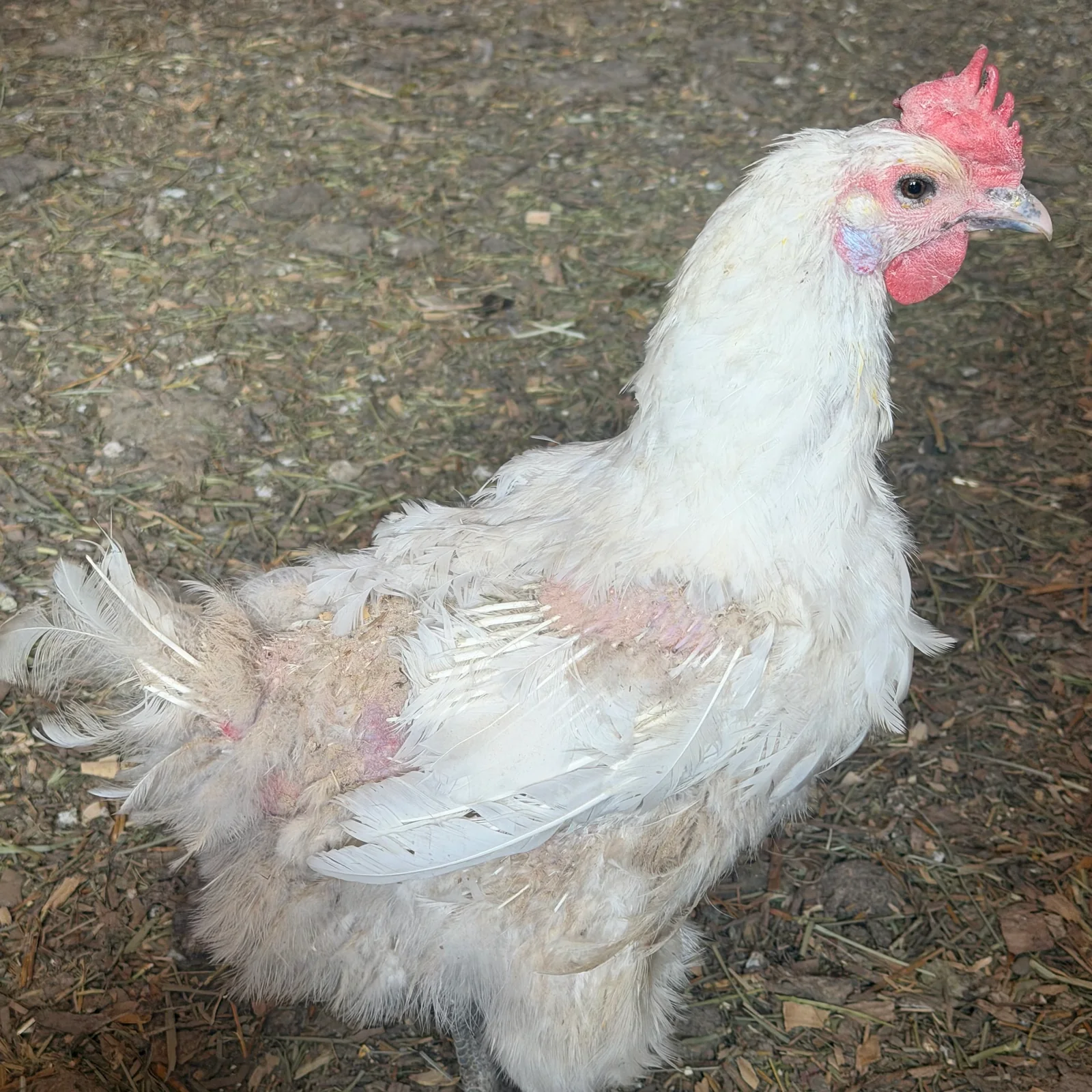
Molting in chickens is usually a normal seasonal change: hens shed worn feathers and grow new ones. Egg laying may slow or stop while they molt (Hermes 2003). Support the bird with complete feed, clean water, and gentle handling. Do not assume that a sick hen is “just molting.”
A healthy molt can leave a once-sleek hen looking ragged. Yet fall feather loss can also reflect mites, lice, pecking, mating wear, or poor feed intake (Mississippi State University Extension n.d.-a). The key question is not just, “Is she losing feathers?” Ask, “Does the whole pattern fit a healthy molt?” Look at new growth, skin, appetite, weight, and behavior, not just the coop floor.
What’s in This Article
- Why, When, and Where Molting in Chickens Happens
- Expected Changes: Chicken Molt Stages, Behavior, and Eggs
- Chicken Feather Anatomy: From Follicle to Finished Vane
- Chicken Molt Nutrition: Building Feathers Without Over-Supplementing
- Chicken Feather Loss: Molt or Something Else?
- A Practical Flock-Side Molt Assessment
- Frequently Asked Questions About Molting in Chickens
- Practical Takeaways for a Healthy Molt
- Conclusion: Support the Bird, Not Just the Feathers
- Literature Cited
Why, When, and Where Molting in Chickens Happens
A mature feather cannot heal. Its exposed part is dead keratin, a tough protein. Worn tips, frayed edges, and broken shafts need replacement, not repair (Chen et al. 2015). New feathers help keep the bird warm and dry, protect the skin, and support limited flight (Yu et al. 2004).
Each feather grows from a living pocket in the skin called a follicle. The same follicle can make one feather after another. Stem cells and a small base of living tissue, the dermal papilla, remain when an old feather is shed. They help start the next growth cycle (Chen et al. 2015).
Young birds replace their early feather coats as they grow (Yu et al. 2004). Adult molt is often most obvious in late summer or fall. Shortening daylight, rather than cold alone, is a major seasonal cue in temperate regions (Hermes 2003).
Light affects signals between the brain, pituitary gland, and ovaries. Thyroid hormones and prolactin also take part, but no single hormone is a simple molt switch. Age, breed, lighting, health, and diet help shape the cycle (Chen et al. 2015). As laying slows, more of the hen’s energy can go toward new feathers (Hermes 2003).
For many hens, molt takes about eight weeks from feather loss to replacement, with a range of one to three months (Texas A&M School of Veterinary Medicine 2021). Illinois Extension describes regrowth in as little as three to four weeks for some hens and 12 to 16 weeks for heavy molters (Illinois Extension n.d.). Hens that start earlier tend to take longer, and most stop laying during molt (Mississippi State University Extension n.d.-b). These are guides, not fixed ranges – many variables factor into feather growth.
Feather loss often starts on the head and neck, then moves over the breast and body before the wings and tail finish. Primary wing feathers also renew in an orderly sequence (Mississippi State University Extension n.d.-b). With gradual, regional loss, some areas keep their cover while others regrow; bare skin is easier to injure (Illinois Extension n.d.).
Neck pins with a full tail can therefore fit a normal molt. Still check the skin, new feathers, appetite, and weight before deciding that the bird is well.
Expected Changes: Chicken Molt Stages, Behavior, and Eggs
Old feathers loosen and fall, leaving thin or bare areas. Pointed pin feathers then emerge inside a protective keratin sheath. As a feather matures, the sheath flakes away and its flat surface, the vane, opens (Yu et al. 2004).
Pins can be tender because their growing cores contain blood vessels and nerves (Yu et al. 2004). Handle the bird gently, and avoid bending or pressing rows of pins (Illinois Extension n.d.). The bird may look untidy, but should stay alert, eat and drink, walk normally, and breathe with ease.
A laying pause often overlaps with shorter days and molt (Hermes 2003). A smaller, less red comb can fit a hen that is not laying; color alone does not prove anemia (Smith n.d.). Marked pallor with weakness, weight loss, or a heavy mite burden needs a broader health check (Murillo 2026b).
Social-media misconception: “A hard molt makes a chicken sick”
A hard molt can look dramatic. That does not make breathing trouble, signs of nerve or brain disease, profound weakness, or major weight loss normal. Do not use molt to explain away a sick bird. Check her appetite, droppings, breathing, gait, and body condition, and seek veterinary help for decline.
Chicken Feather Anatomy: From Follicle to Finished Vane
The follicle is a pocket of the outer skin layer that dips into deeper skin. At its base, the dermal papilla and a collar of growing cells help build the feather. Living pulp fills the growing core (Yu et al. 2004).
The calamus is the hollow lower shaft seated in the follicle. Above it, the rachis forms the central shaft. Branches called barbs extend from the rachis to form the vane. Each barb carries smaller branches called barbules (Yu et al. 2004).
In the firm, or pennaceous, part of a vane, tiny hooklets catch the next barbule like a zipper. The downy base has loose barbules that help trap air instead. Contour feathers shape and protect the body; down helps hold warmth, and flight feathers form the wing’s flight surface (Yu et al. 2004).
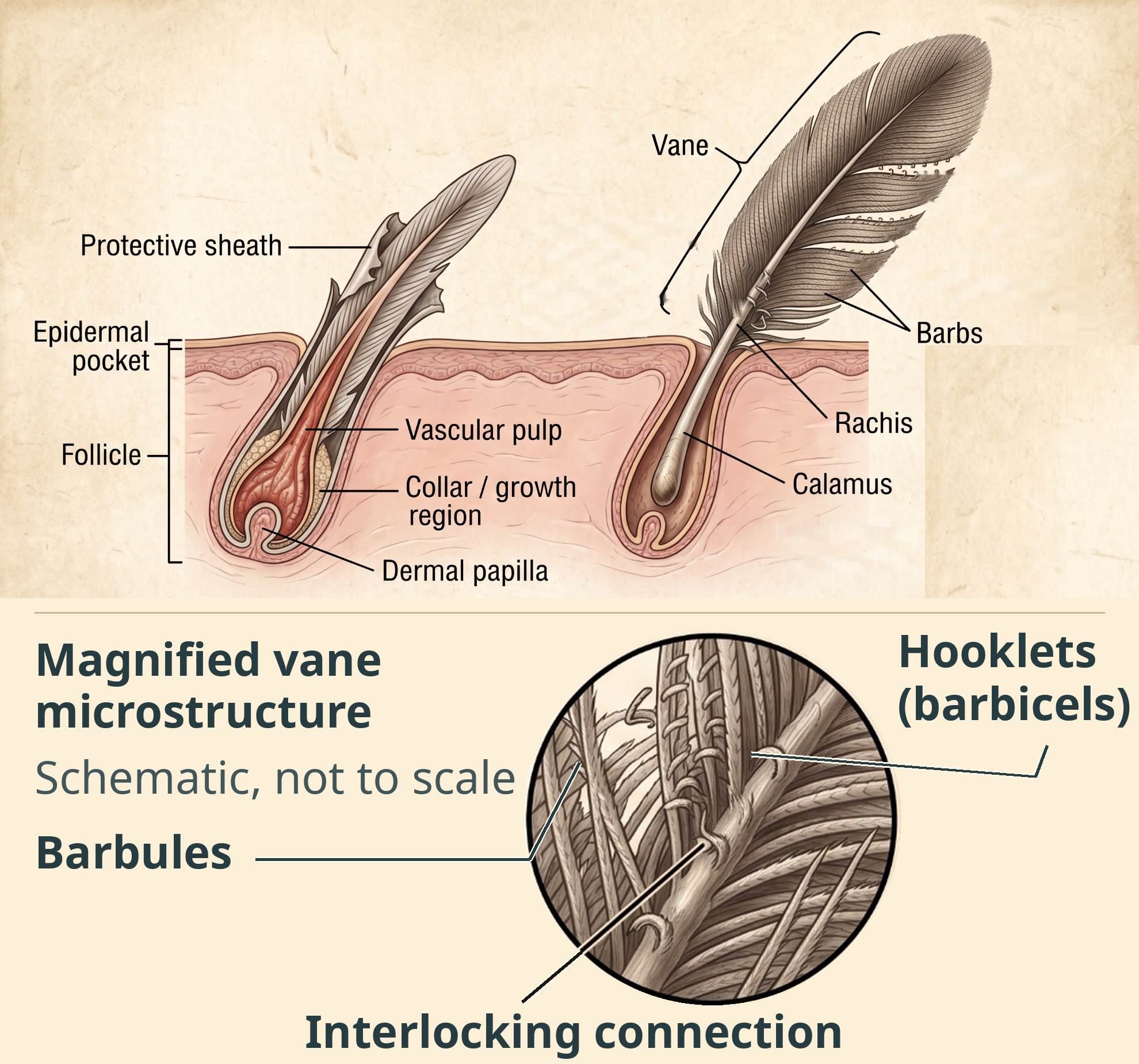
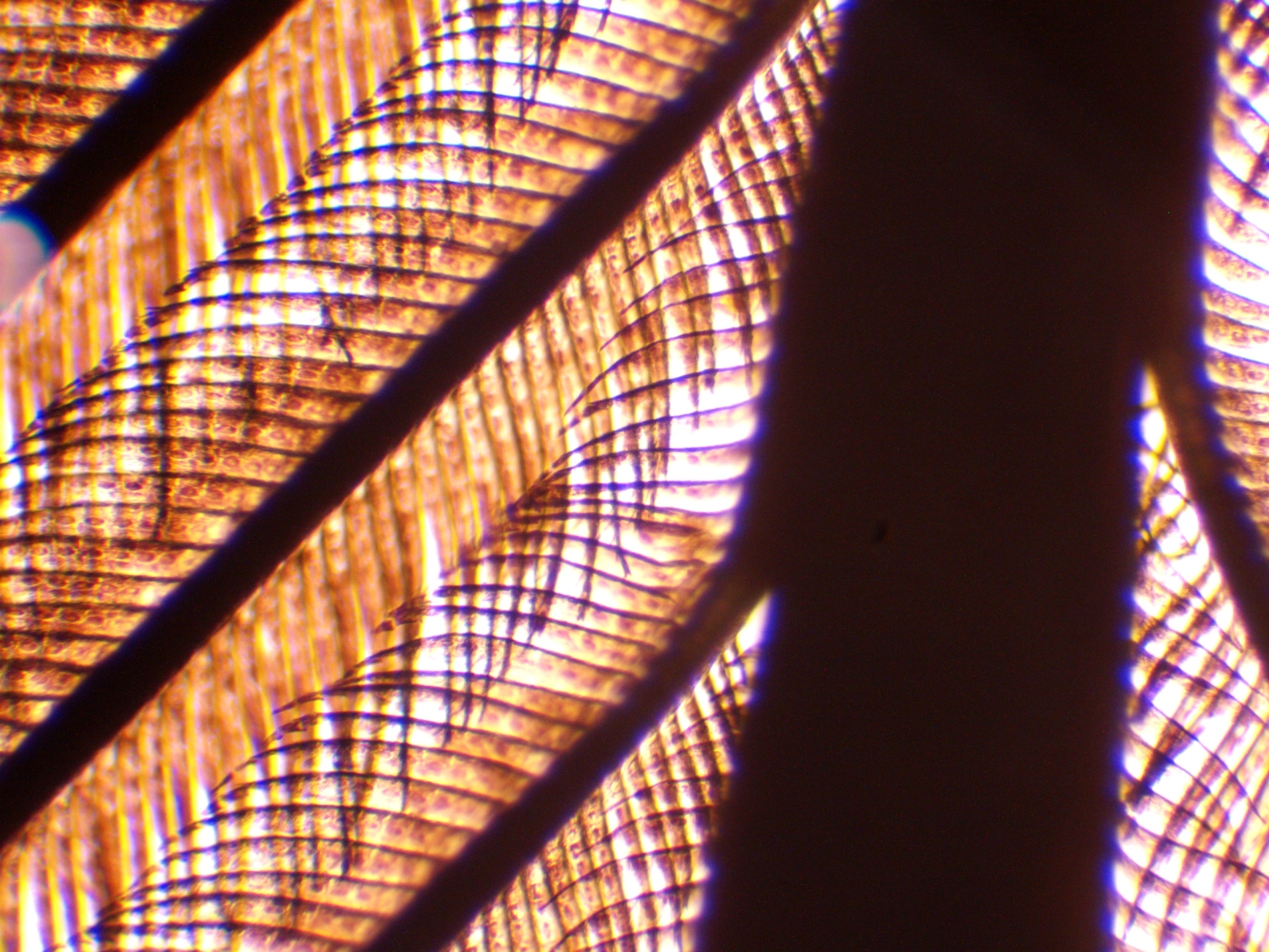
“Blood feather” describes a feather’s blood-supplied growth stage, not a separate feather type. The tip matures first. As growth ends, pulp is absorbed back toward the base, the sheath breaks down, and the vane opens (Yu et al. 2004).
Dry sheath flakes can look like dandruff. Flakes alone do not diagnose mites. Look for intact, pointed pins over clean skin. Broken pins, crusts, marked redness, intense scratching, or no new growth warrant a closer check (Murillo 2026a, 2026b).
If a growing feather bleeds, keep the bird safe from pecking flockmates and apply gentle direct pressure. Seek veterinary help if bleeding persists. Removing a damaged blood feather is a veterinary procedure; pulling one at home risks pain, follicle injury, and more bleeding (Graham n.d.).
Chicken Molt Nutrition: Building Feathers Without Over-Supplementing
Start with a reputable complete feed suited to the birds’ age and class. Offer it freely with clean water. Treats should not crowd out the balanced ration (Hermes 2003). Scratch, scraps, mealworms, eggs, tuna, and cat food are not substitutes for complete feed.
Crude protein estimates nitrogen in feed. It does not tell you the full balance of amino acids, their digestibility, the feed’s energy, or how much a hen eats (Alabi and Adedokun 2025). Amino acids are the building blocks of protein. Think of them as barrel staves: the shortest stave limits what the barrel can hold.
Methionine and cysteine help build feather keratin. Lysine supports body-protein growth, and chickens also need arginine in their diet (Alabi and Adedokun 2025). A shortage of arginine can cause cup-shaped feathers. With too little energy, the bird burns amino acids for fuel rather than building tissue (Korver 2024b).
Mississippi State Extension identifies a shortage of a key amino acid, often methionine, as a common reason feathers fail to develop. Adding grain to complete feed can dilute that balance (Mississippi State University Extension n.d.-a).
Social-media misconception: “A 28% protein feed grows feathers faster”
Molt does not automatically call for a high-protein feed. The aim is enough usable amino acids in a balanced ration, not the highest number on the bag (Alabi and Adedokun 2025). A higher-protein feed may fit a professionally planned program, but its percentage alone does not show whether it suits your flock.
More protein cannot fix low intake, the wrong amino-acid balance, or disease. Surplus amino acids also add nitrogen for the bird to excrete (Alabi and Adedokun 2025).
Social-media misconception: “Scratch keeps chickens warmer”
Scratch is not a required winter heating ration. Large servings can crowd out complete feed and dilute key nutrients (Hermes 2003). Focus on balanced feed, water, dry shelter, and good feather cover. See our video on evaluation of bald chickens and their feeding program.
Vitamins, minerals, and feather color
Shortages of several vitamins and minerals can affect feather growth or health. Examples include brittle shafts with too little folate, poor feathering with zinc shortage, and loss of feather pigment with iron shortage (Korver 2024a, 2024c). These signs are reasons to review the whole diet, not to guess at a supplement.
Excess selenium is toxic and can cause feather loss. Do not add selenium to complete feed without veterinary or poultry-nutrition guidance (Bischoff 2024).
Feather color depends chiefly on genes, melanin pigments, and feather structure. Eumelanin gives black and dark brown tones; pheomelanin gives red and yellow tones (Zheng et al. 2020). Small-scale feather structure can also create iridescence (Yu et al. 2004).
Chicken studies link red-brown shades to several candidate genes and yellow feathers to changes in pigment pathways. These are genetic findings, not tests of color-changing feeds (Fogelholm et al. 2020; Zheng et al. 2020). Carotenoid pigments from feed are uncommon in chicken feathers, so marigold or paprika should not be promised to transform adult plumage (Fogelholm et al. 2020).
Complete feed supplies energy so amino acids can be used to build keratin rather than burned for calories.
Chicken feathers are roughly 90 percent keratin. One review lists approximate feather-protein shares of 14 percent serine, 14 percent glycine, 10 percent proline, 8 percent cysteine, and less than 1 percent lysine. Serine ranks first and glycine second in that table (Moktip et al. 2025). These describe feathers, not feed targets.
Although feathers are rich in serine, glycine, and proline, these amino acids are generally more available in poultry diets than the amino acids most likely to limit feather growth. Methionine is often the first limiting amino acid in typical poultry rations. It also supplies sulfur for cysteine production (Alabi and Adedokun 2025). Serine supplies the carbon and nitrogen backbone that receives that sulfur (Sbodio, Snyder, and Paul 2019). This is why the mix matters, not just the total protein.
Cysteine forms strong sulfur links, called disulfide bonds, that help make keratin firm. Glycine helps keratin pack tightly (Moktip et al. 2025). Proline helps its sheets fold and hold their shape (Sheikh Hosseini et al. 2025). Feathers contain little lysine, but the bird still needs it for body-protein growth (Alabi and Adedokun 2025).
Merck’s poultry nutrition chapters describe these other roles and shortage signs:
- Zinc: Needed for normal feathering; too little can cause poor, frizzled feathers in chicks (Korver 2024a).
- Iodine: Needed for thyroid hormones that help control feather growth; shortage can produce long, lacy feathers (Korver 2024a).
- Iron: Needed for normal feather pigment; shortage can cause color loss, with a clear line when the diet is corrected (Korver 2024a).
- Biotin (B7): Supports skin health and energy use; shortage can inflame skin around the beak, eyes, and feet, much like pantothenic acid deficiency (Korver 2024c).
- Pantothenic acid (B5): Part of coenzyme A, which helps process fats, sugars, and amino acids; shortage can cause ruffled, brittle feathers (Korver 2024c).
- Folate (B9): Supports rapidly dividing cells; shortage can cause weak, brittle shafts and loss of pigment (Korver 2024c).
These details explain the value of balanced feed, not a need to stack supplements. Extra grain can dilute key nutrients even when the base feed is complete (Mississippi State University Extension n.d.-a). The clinical signs of nutrient deficiencies detailed and pictured in scientific articles and veterinary textbooks are often produced in research settings where birds were deliberately fed diets lacking a specific nutrient. Although these deficiency signs are well documented, they are uncommon in birds that consume an appropriate, properly stored complete feed as the main part of their diet. They are more likely when a diet is unbalanced, diluted with substantial treats or grain, improperly mixed, poorly stored, or not eaten adequately; therefore, feather changes should prompt a review of the whole feeding program and the bird’s health rather than automatic use of individual supplements.
Check the feed label for species, life stage, a complete-feed statement, and feeding directions. Check freshness, dry storage, and all added supplements. Match calcium to flock needs, not to the season.
Chicken Feather Loss: Molt or Something Else?
Molt and parasites can occur together. Itching, damaged feathers, inflamed skin, dirty vent feathers, or visible pests call for closer inspection (Murillo 2026a, 2026b).
Poultry red mites feed mostly at night and hide in cracks by day. Northern fowl mites stay on the bird and often cluster near the vent. Other mites irritate feather bases (Murillo 2026b). Part feathers around the vent and under the wings to look for chewing lice and egg masses glued to feather bases (Murillo 2026a).
Identify the pest before treatment. Product legality and egg-withdrawal instructions vary (Murillo 2026b). The Poultry Doc’s guide to drugs used for common poultry ectoparasites provides more context.
Pecking, mating, and contact with equipment can cause local damage rather than orderly feather loss. Rooster wear often affects the back or head (Mississippi State University Extension n.d.-a). Watch for repeated targeting, tight openings, and rough contact points. Review space, feed and water access, light, and diet.
Social-media misconception: “Feather loss in fall is always molt”
Season is a clue, not a diagnosis. Check the pattern, new growth, skin, and whole-bird health. Poor intake, chronic disease, parasites, and stress can also affect feathers or laying (Hermes 2003).
Artificial light affects laying, but it is not a reset button. Avoid sudden changes and continuous-light “hacks.” A lighting program should be gradual and consistent, with an adequate dark period (Hawes 2021).
A Practical Flock-Side Molt Assessment
Use this five-step check:
- Context: Note season, age, recent laying, feed or light changes, stress, and how many birds are affected.
- Pattern: Look for orderly replacement, often neck-first, rather than local or uneven damage.
- Regrowth: Check for intact, pointed pins. Note broken or bleeding pins and areas with no regrowth.
- Skin and pests: Inspect the vent, under the wings, feather bases, roosts, nests, and coop cracks.
- Whole bird: Check appetite, water intake, weight, breast muscle, comb color, droppings, breathing, gait, and alertness.
Take weekly photos from the same angles, and record weights when practical. Limit handling that bends tender pins (Texas A&M School of Veterinary Medicine 2021).
Orderly regrowth, intact pins, normal intake, stable weight, and easy breathing fit a healthy molt. Broken back feathers, egg masses, intense scratching, or active pecking need investigation.
Seek prompt veterinary care for trouble breathing, severe weakness, marked pallor, major weight loss, dehydration, neurologic signs, persistent bleeding, extensive wounds, or failure to eat or drink. Rapid decline in several birds also needs help, not a wait for molt to end. The TPD diagnostic laboratory is a resource when flock disease needs testing.
Frequently Asked Questions About Molting in Chickens
How can I tell molt from mites?
Look for orderly loss with intact new pins. Itching, damaged skin, pests, or egg masses point to another problem. Molt and parasites can coexist.
Is neck-first molt normal?
Often, yes. Neck pins with a full tail can fit the usual sequence. Confirm that the skin and bird are otherwise well.
Why did laying stop, and is a pale comb normal?
Shorter days and molt often overlap. A smaller, less red comb can fit a laying pause. Marked pallor with weakness or weight loss does not.
Should I use high-protein feed or treats?
Start with complete feed that suits the flock and is being eaten. A 28 percent protein claim does not establish a need. Eggs, tuna, cat food, and mealworms cannot replace a balanced ration.
Should I add vitamins or scratch?
Do not add supplements just in case. Review feed quality and intake first. Scratch is not a required heat source and can dilute the diet.
Can lights restart eggs, and when should I call for help?
Do not use abrupt or nonstop light as a shortcut. Do not wait through illness, injury, breathing trouble, persistent bleeding, or failure to eat and drink.
Practical Takeaways for a Healthy Molt
- Expect seasonal feather loss, but assess the whole bird.
- Look for orderly regrowth and intact pins over clean skin.
- A laying pause can fit molt; serious illness does not.
- Use complete feed. Energy and amino-acid balance matter more than a high protein percentage.
- Do not diagnose deficiency or add selenium based on feather color alone.
- Check for pests, pecking, mating wear, and injury when the pattern does not fit.
Conclusion: Support the Bird, Not Just the Feathers
A hen can look untidy without being unwell. Support her with complete feed, water, gentle handling, stable lighting, and close observation. Do not chase supplements while missing poor intake, damaged skin, or illness. Good molt care is whole-bird care.
Literature Cited
Alabi, Taiwo, and Sunday Adedokun. 2025. “Amino Acid Nutrition in Poultry: A Review.” Animals 15 (22): 3323. https://pmc.ncbi.nlm.nih.gov/articles/PMC12649615/.
Bharathi, S. V., and Indu V. Raj. 2021. “Comparative Studies on the Amino Acid and Protein Content of Broiler and Layer Chicken Feathers.” International Journal of Current Microbiology and Applied Sciences 10 (7): 446–51. https://www.ijcmas.com/10-7-2021/S.%20V.%20Bharathi%20and%20Indu%20V.%20Raj2.pdf.
Bischoff, Karyn. 2024. “Selenium Toxicosis in Animals.” Merck Veterinary Manual. Last updated September 2024. https://www.merckvetmanual.com/toxicology/selenium-toxicosis/selenium-toxicosis-in-animals.
Chen, Chih-Feng, John Foley, Pin-Chi Tang, Ang Li, Ting Xin Jiang, Ping Wu, Randall B. Widelitz, and Cheng Ming Chuong. 2015. “Development, Regeneration, and Evolution of Feathers.” Annual Review of Animal Biosciences 3: 169–95. https://doi.org/10.1146/annurev-animal-022513-114127.
Fogelholm, J., R. Henriksen, A. Höglund, N. Huq, M. Johnsson, R. Lenz, P. Jensen, and D. Wright. 2020. “CREBBP and WDR 24 Identified as Candidate Genes for Quantitative Variation in Red-Brown Plumage Colouration in the Chicken.” Scientific Reports 10 (1): 1161. https://doi.org/10.1038/s41598-020-57710-7.
Graham, Jennifer. n.d. “Stabilizing the Avian Trauma Patient.” Clinical handout. Hosted by Auburn University College of Veterinary Medicine. Accessed September 6, 2026. https://www.vetmed.auburn.edu/wp-content/uploads/2019/10/4_Stabilizing-the-Avian-Trauma-Patient_GRAHAM.pdf.
Hawes, Robert. 2021. “Maine Poultry Facts: Lighting for Small-Scale Flocks.” Reviewed and updated by Richard Brzozowski, Donna Coffin, and Colt Knight. Bulletin 2227. University of Maine Cooperative Extension. https://extension.umaine.edu/publications/2227e/.
Hermes, James. 2003. “Why Did My Chickens Stop Laying?” PNW 565. Oregon State University Extension Service. Reviewed 2023. https://extension.oregonstate.edu/catalog/pnw-565-why-did-my-chickens-stop-laying.
Illinois Extension. n.d. “Molting of Laying Hens.” University of Illinois. Accessed September 6, 2026. https://www.uiearchive.web.illinois.edu/lms/downloads/60526.pdf.
Korver, Doug. 2024a. “Mineral Deficiencies in Poultry.” Merck Veterinary Manual. Last updated September 2024. https://www.merckvetmanual.com/poultry/nutrition-and-management-poultry/mineral-deficiencies-in-poultry.
Korver, Doug. 2024b. “Protein, Amino Acid, and Energy Deficiencies in Poultry.” Merck Veterinary Manual. Last updated September 2024. https://www.merckvetmanual.com/poultry/nutrition-and-management-poultry/protein-amino-acid-and-energy-deficiencies-in-poultry.
Korver, Doug. 2024c. “Vitamin Deficiencies in Poultry.” Merck Veterinary Manual. Last updated September 2024. https://www.merckvetmanual.com/poultry/nutrition-and-management-poultry/vitamin-deficiencies-in-poultry.
Mississippi State University Extension. n.d.-a. “Causes of Poor Feathering.” Accessed September 6, 2026. https://extension.msstate.edu/agriculture/livestock/poultry/causes-poor-feathering.
Mississippi State University Extension. n.d.-b. “Molting of Laying Hens.” Accessed September 6, 2026. https://extension.msstate.edu/agriculture/livestock/poultry/molting-laying-hens.
Moktip, Thanakorn, Lakha Salaipeth, Ana Eusebio Cope, Mohammad J. Taherzadeh, Takashi Watanabe, and Paripok Phitsuwan. 2025. “Current Understanding of Feather Keratin and Keratinase and Their Applications in Biotechnology.” Biochemistry Research International 2025: 6619273. https://pmc.ncbi.nlm.nih.gov/articles/PMC12041636/.
Murillo, Amy C. 2026a. “Lice of Poultry.” Merck Veterinary Manual. Last updated January 2026. https://www.merckvetmanual.com/poultry/arthropods-in-poultry/lice-of-poultry.
Murillo, Amy C. 2026b. “Mites of Poultry.” Merck Veterinary Manual. Last updated February 2026. https://www.merckvetmanual.com/poultry/arthropods-in-poultry/mites-of-poultry.
Sbodio, Juan I., Solomon H. Snyder, and Bindu D. Paul. 2019. “Regulators of the Transsulfuration Pathway.” British Journal of Pharmacology 176 (4): 583–93. https://pmc.ncbi.nlm.nih.gov/articles/PMC6346075/.
Sheikh Hosseini, Mehrnaz, Zahra Moosavi-Nejad, Fatemeh Rezaei Sadrabadi, and Hamid Hosano. 2025. “Antioxidant Peptide Production Using Keratin from Feather Waste: Effect of Extraction and Thiol Blocking Method.” International Journal of Molecular Sciences 26 (9): 4149. https://pmc.ncbi.nlm.nih.gov/articles/PMC12071990/.
Smith, Tom W. n.d. “Culling Hens.” Publication 358. Mississippi State University Extension Service. Accessed September 6, 2026. https://www.poultry.msstate.edu/pdf/extension/culling.pdf.
Texas A&M School of Veterinary Medicine. 2021. “Hen Molting: What to Egg-spect.” February 19, 2021. https://vetmed.tamu.edu/news/pet-talk/hen-molting/.
Yu, Mingke, Zhicao Yue, Ping Wu, Da-Yu Wu, Julie-Ann Mayer, Marcus Medina, Randall B. Widelitz, Ting-Xin Jiang, and Cheng-Ming Chuong. 2004. “The Developmental Biology of Feather Follicles.” International Journal of Developmental Biology 48 (2–3): 181–91. https://doi.org/10.1387/ijdb.031776my.
Zheng, Xiaotong, Bo Zhang, Yawen Zhang, Haian Zhong, Ruixue Nie, Junying Li, Hao Zhang, and Changxin Wu. 2020. “Transcriptome Analysis of Feather Follicles Reveals Candidate Genes and Pathways Associated with Pheomelanin Pigmentation in Chickens.” Scientific Reports 10 (1): 12088. https://doi.org/10.1038/s41598-020-68931-1.